date everything!
review
i’m going to start with a really weird analogy. let’s say you have a glass of water, and want to make some ice. you have 3 ice trays in front of you; one makes 2 large ice cubes (think of the ones that go into rocks glasses), one makes 10 regular-sized ice cubes (the stuff that you might get at the gas station), and one makes 50 tiny ice cubes (if you’ve ever been to raising canes, think those ones).
the easiest one to fill is going to be the large ones, right? you have a little more wiggle room, and even if you underfill them a little, you still have great, dense ice cubes. the problem is that you only get two of them; if you want ice more than twice, or if you have people over, it’s not super practical to use the large tray. the medium ice cubes are still easy to fill, and provide enough separate cubes so that more people can use the ice. this is generally the best option for when you’re at home.
date everything feels like the tiny ice cube tray. the tiny cubes are a pain in the ass to fill up, so you end up spilling water everywhere, and while you’re left with a ton of individual ice cubes, each person needs more ice to keep their drink cool, because the ice melts much faster. it’s extremely impractical to make ice like this, unless you’re making it in bulk (which, in this example, we are not).
100 characters sounds like a really cool idea, until you learn that each one has one or two key personality traits and nothing else. there’s a ton of options, but none of the routes are all that deep; if you do like a character, don’t expect them to evolve or change in any meaningful way. and, while it does mean that you have more time to interact with a ton of different “people” in the house, it also means that there’s a good chance you won’t like a character.
each route goes something like this: you are introduced to a character, they show their little gimmick or problem, you talk with them (or a related character) about said problem, said problem gets solved, and you make the choice to romance them, befriend them, or antagonize them. this loop repeats over, and over, and over. there is no depth, why would you ever want that?
that lack of depth is combined with a writing style i can only describe as “blunt”. every character’s theme - whether it be struggling with executive dysfunction, or self-identity, or their sexuality and sexual habits - is bashed over your head with the subtlety of a Ford F-150 ramming towards you at max speed. any semblance of a lesson must be shown to the reader immediately, with no tact. it almost feels condescending at times. the attempts at humor are also extremely, extremely corny; as soon as i saw the dialogue option for “one heck of a pupper”, i immediately closed my game. i couldn’t handle it.
oh, but don’t worry! you can’t even blitz through a character route in one go! that must be separated by the game’s day/night cycle; some objects are only open at different times on different days, and you can only talk to an object once a day. you MUST use all 5 opportunities you are allotted each day to talk to 5 different objects, which means you’re always balancing 4 or 5 routes at any given time. plus, most of the characters require you to talk to other characters to progress their route, which means wasting even more time before you can continue their (usually vapid) plots.
plus, on top of it all, the game’s progression system means, to get a single “true” character ending, you need to finish the routes of OVER HALF OF THE CAST. i wanted to get both maggie’s and daisuke’s “realization” endings (which consist of about two minutes worth of extra text and a single CG, i learned) but never did because of how much extra effort it would take.
that’s the big problem: i genuinely did not care for most of the cast, and did not care about how most characters were written, but if i wanted to get the extra content for the few i actually do care about, i have to play through literal dozens of extra routes just because. plus, it’s not like there’s just a number of characters you have to interact with; it’s based on stats and attributes, which means you have an even more limited pool of objects to choose from, based on what quality they give you at the end of their route. it’s overcomplicated and annoying.
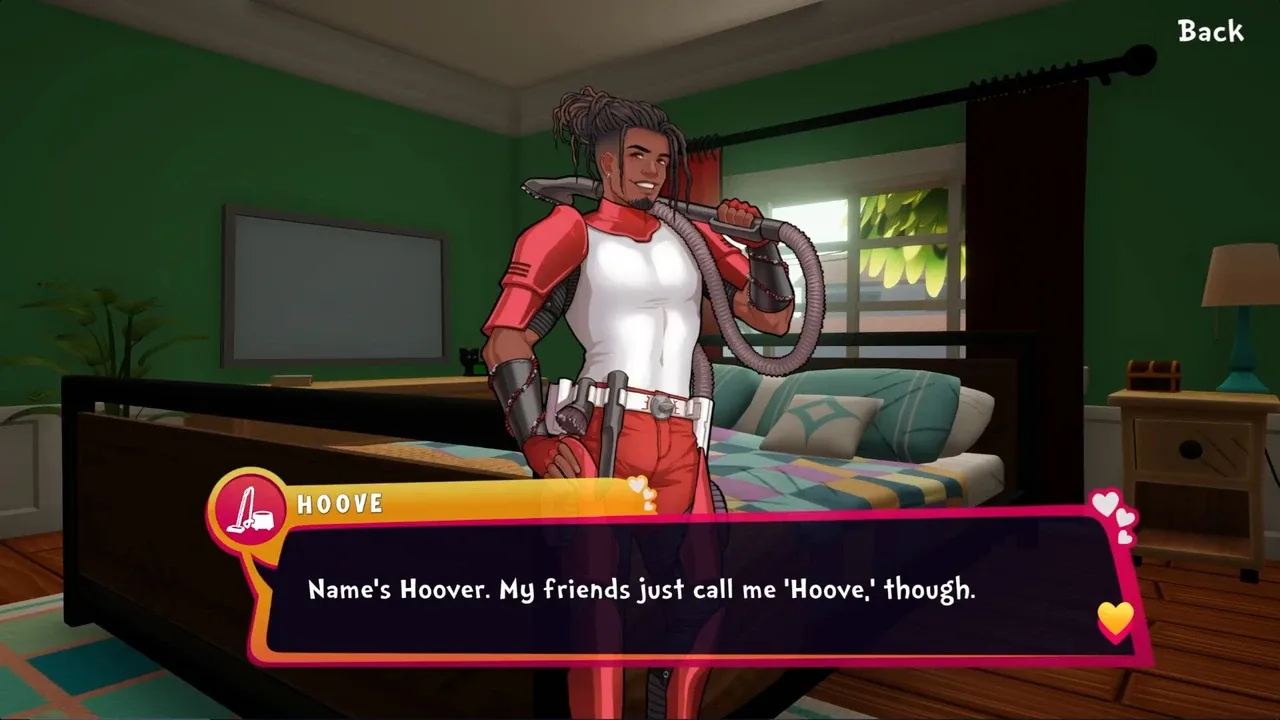
the worst part about it all is that the main selling point, the game’s character designs and voice acting, is consistently AMAZING! the art team and voice actors did a great job with what they were given, and you can tell that there was passion behind how this game was presented. i think it’s why this game became so popular; when seen in small chunks that let the voice and art work shine, it looks like the game has a kind of polish that it just doesn’t have when actually playing it.
date everything would’ve made an awesome web-series or something. in a format where the scope could be kept smaller and more details could’ve been put into the writing, the already great aesthetics would’ve been able to shine even more than they already do. as a video game, though? it’s underwhelming in some areas, frustrating in others.
score
3/10
notes
- developed by Sassy Chap Games
- published by Team17
- released in 2025
- played on pc
- crossposted to backloggd