persona 4 golden
review
i’m a little conflicted with persona 4 golden.
it is, unequivocally, a fantastic video game. that’s not what’s up for debate here. it’s another great persona game, with a likable party of societal outsiders going on to kill cosmic horrors. you’re given a great chance to connect with all of the friends that surround you through their social links, and those links help to flesh out each character’s motivations and show more tangible growth throughout the game. the game’s rpg elements are also mechanically deep enough to keep the game smooth during its multiple dungeons, and there’s enough accessibility options for everyone to play the game as they please. that’s all still there, and still great.
naturally, i compared persona 4 golden to the other persona game i’ve played, being persona 3 reload and… it doesn’t compare. i realized i just didn’t care all that much about a good chunk of the new cast, i didn’t care at all about any non-familial side characters, and the plot itself felt a lot less cohesive while remaining the previous game’s heavy-handed theming. even in the elements of the game i do prefer, being (ALMOST) everything on the mechanical side of things, they’re not drastic improvements, and they come with obvious caveats.
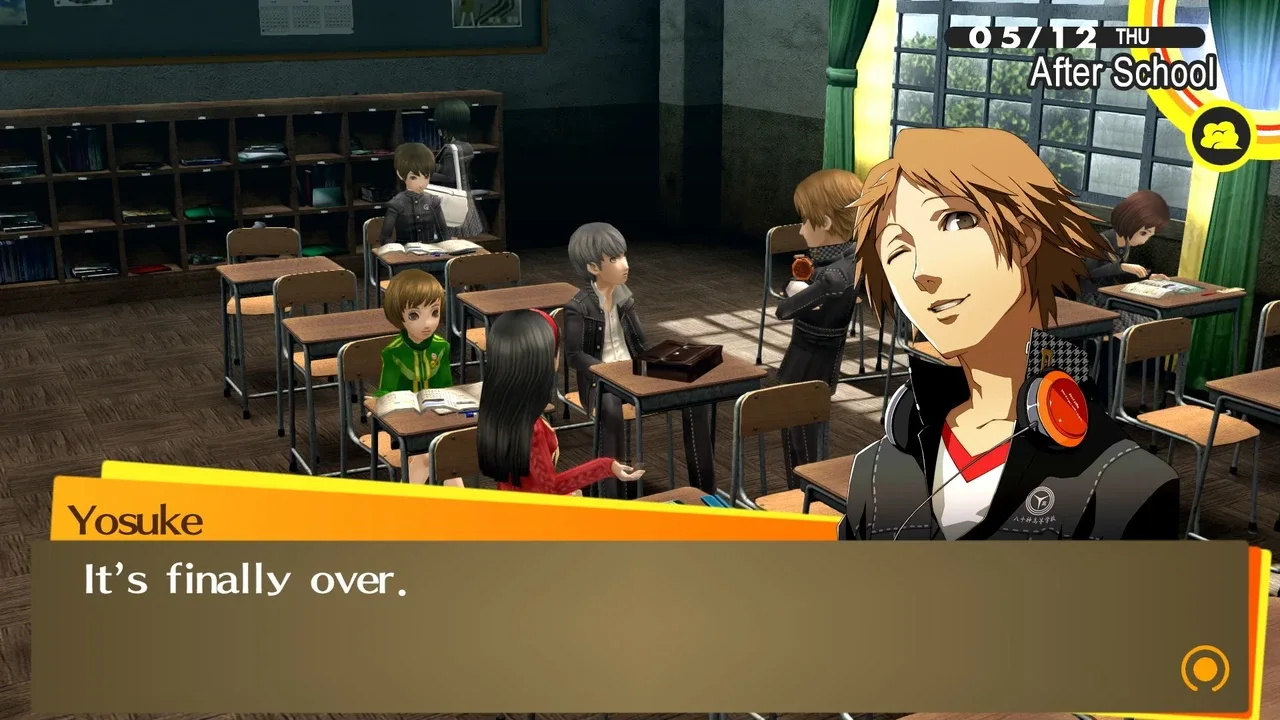
and - i need to reiterate - this doesn’t mean persona 4 golden is a bad video game, far from it. i still quite like a good couple of the characters and their social links. yosuke grapples with the death of someone close to him, while subsequently realizing that his care was one-sided. naoto rediscovers her love for mystery, and learns to accept her life as a woman instead of forcing herself to change for others. kanji accepts his interests instead of hiding behind a tough-guy persona, and starts running classes to share his talent.
this game also has by far the single best set of social links between either of the two games i’ve played, in dojima and nanako’s respective social links. dojima struggles to move on from the death of his wife, as he sees her in his kid all the time. he’s been a shitty father, and he can’t exactly undo that, but he tries his damndest to move on from the past and actually put in the effort to care for his kid. nanako tries to understand why her father isn’t spending time with her, and you have to help her accept that, though her father isn’t always there for her, he still cares for her more than anything. they’re truly heartbreaking, and work to create far and away the best two links in the game.
the game as a whole shows the characters challenging societal expectations, being true to yourself, and overcoming past trauma. sometimes it’s navigating fame or power, and the problems that come with it. other times it’s challenging standard gender roles through your interests or job. that theme fits really nicely with the more down-to-earth setting of inaba, a tiny town in the middle of nowhere, where everybody knows everybody and rumors spread fast.
the big, main narrative focuses mostly on exploring and saving people from the midnight channel, another world inside a TV. people are seemingly being thrown in, and when someone is in this world, they appear on an unpowered TV at midnight. it’s interesting, for sure, and because you’re working to save a group of individuals instead of “all of humanity”, it allows every dungeon to feel more personalized and unique. whether it be through slight puzzles, unique teleportation mechanics or turning doors into shadows, every dungeon has at least one unique property that impedes your progress in a way reminiscent of the victim’s personality. they’re all themed around said person’s “shadow side” as well, some property that they’re trying to hide from themselves. it makes every dungeon for more unique than the sections of tartarus.
unfortunately, a lot of that mechanical improvement is nulled out by how truly and genuinely annoying the bossfights are in this game. each one has the same, extremely boring pattern: find the gimmick, protect yourself from the gimmick, slowly wittle down the health. sounds fun, until you realize that the gimmick rarely changes, and these fights take damn near an hour each. it’s not as bad in persona 3 because the bombastic bosses are few and far between, but here, every dungeon has at least one dreadfully long fight. it’s infuriating.
the game’s big twist is really well executed, but i think the steps to achieve said big twist are unfortunately extremely confusing and pretty cryptic. the new, exclusive stuff to golden struggle from a very similar issue. still great, and extremely fun, but dreadfully complicated to get to and horridly foreshadowed.
i think the endgame most clearly illustrates the biggest problem that i have with persona 4 golden: it just constantly gets in its own way. pretty much every character has an interesting base, but a couple of them fail to get meaningful development through social links. the small town creates a really interesting setting, but the lack of meaningful side characters fails to truly induce the “everybody knows everybody” atmosphere. the dungeons are fantastically themed with wonderful story beats that build the story beautifully, but they consistently end on its worst foot. the game has a lot of really cool content with a reasonably interesting premise and some fantastic story beats, but it just fails to consistently build off of it all. when it’s good, it’s some of the best writing in any video game i’ve played. when it’s not, it struggles to hold my attention.
score
8/10
notes
- developed by Atlus
- published by Sega
- released in 2020
- played modern port
- played on switch
- crossposted to backloggd