the world ends with you
review
there are some games that are just meant to be played on original hardware. whether it be a strange control scheme or a console-exclusive gimmick, certain experiences are just better as originally intended. going into the world ends with you, this was something i was well aware of, so i shelled out the extra dough to pick up a complete copy of the game on DS. as i don’t own any model of the original DS, i instead played the game on my new 2DS XL, which, in my eyes, would just improve the experience.
it did not. the world ends with you, to me, often felt extremely overwhelming, as the top and bottom screens both use largely separate combat systems, and looking between the two was just too much on the brain. i talked about this disconnection in a discord server i’m in, and PhantasM, another person who played the game on a larger handheld, shared largely the same sentiment.
the world ends with you is the only game i can think of where playing on the original DS instead of a larger 3DS model is legitimately necessary for most people. because the game’s combat is… let’s just say, a little chaotic at times, having less screen and a smaller gap in between the two screens is legitimately game-changing. that’s not to say the combat in twewy is awful even on a larger handheld, but i found myself consistently missing combos on both the top and bottom screens more than i would’ve had i played on a more compact system.
the combat system itself is genuinely excellent, and rather innovative for an earlier DS release. both screens have simple controls, the bottom “main” screen being a beat-em-up controlled by the stylus, and the top “partner” screen being some sort of puzzler-arcade-y combo taking inputs from the d-pad (or ABXY, if you’re a lefty). as the story evolves, your partner will change, and with a new partner comes a new combo system. while each character is controlled separately, you can’t really ignore either if you’d like to maximize your damage output, as continuing combos on the top screen fuels fusion attacks that damage everything in sight.
and that’s sort of the crux of it all, right? you can’t ignore either screen, but on a larger device, it’s hard to focus on both at once, especially with how fast-paced some of the battles get. it’s a tough balance to manage when both screens are visible in your regular view; juggling both combos when you can’t was, at least to me, nigh impossible.
and maybe that’s all on me, for playing on a bigger set of screens than what was designed. what’s decidedly not my fault, though, is how repetitive this game gets in every aspect, not just in its gameplay.
it’s easiest to start with the battles, while we’re still on the topic. each battle pits you up against a set of a couple different enemies called noise. there are a ton of different enemies that you encounter throughout the game, and each area has a distinct set of possible encounters which change as you progress. the problems arise when you’re forced to fight 3-4 of these battles in a row, meaning you’re often battling against the same set of noise over, and over, and over. not to mention segments, especially near the end of the game, where missions consist of fighting multiple of the exact same type of enemy to progress anywhere on the map. their patterns don’t change, so it feels less like a challenge and more like a waste of time.
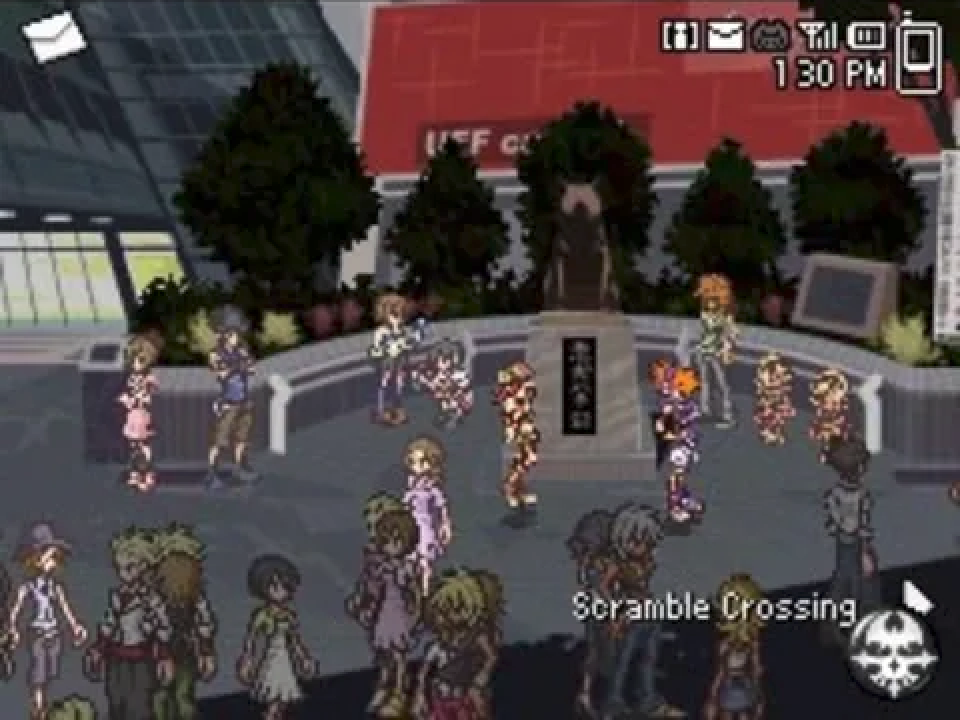
even moving around shibuya gets a little tedious at times. while the city is beautifully portrayed in twewy’s distinct art style, you eventually get bored of walking the same routes to the same locations over, and over, and over. it’s made worse by the game’s structure, which often places you right back in the scramble after a chapter is finished, meaning you’re walking to the other side of the map over again. it’s not the worst by any means, but it is noticeable, and that tedium adds up throughout the course of the game.
even the story falls victim to this, though to a far lesser extent. i like most of the characters: neku’s development from coldhearted, isolated asshole to a still-blunt yet caring teen is great, shiki is a wonderful take on jealousy and the benefits of being yourself, rhyme and beat make a great duo that bounce off each other wonderfully, and… we don’t have to talk about joshua. the whole “expand your world, open your horizons, be yourself” theming is really well-done, and the crowded, trendy setting of shibuya works perfectly to complement the overarching narrative. some villains are reasonable and fun, others are a little over-the-top, but all of them have interesting and fleshed out motivations that i genuinely enjoyed learning about. i have very few problems with the actual narrative itself, and the vast majority of those problems come down to me just not liking joshua as a character.
the issues arise in how this story is told; the game LOVES extremely obvious foreshadowing, often to its detriment. a good chunk of the story beats, including major twists, will often be introduced through little chunks of dialogue between side characters well before they’re introduced. it’s extremely apparent when you’re being fed information that you need to remember, and when the twists actually come up, sometimes they just don’t hit as hard as they should, because you’re given a lot of the details far ahead of time.
the world ends with you frustrates me in a lot of ways, because i see how this game could be really cool, while also understanding that my time with it was likely hampered by a less-than-optimal choice of handheld. had i played this on the right console, i could easily see this being a better experience, but there are still flaws baked into the core of this game that would pop up regardless of how i played it. i didn’t even mention how the game bombards you with way too many text-based tutorials, or the amazing music being used over, and over, and over again.
i don’t want to discount how good this game is, because each element of it is really, REALLY interesting. the combat, on its own, is an amazing concept with solid execution. it’s aesthetically distinct in both its art and music. the narrative has excellent theming with a cast of likable, fun characters who genuinely evolve throughout the course of the game, and the ending ties everything up rather nicely.
the best analogy i can use for the world ends with you is a puzzle where every little divot that connects the pieces together was cut off. you can still put the puzzle together, but it’s not stable, and there are little holes missing everywhere. twewy has all the right pieces, but it fails to connect them in meaningful ways, leading to a fun, yet slightly underwhelming experience.
score
7/10
notes
- developed by Jupiter
- published by Square Enix
- released in 2007
- played on 3ds
- crossposted to backloggd