zero escape: virtue’s last reward
review
i recently replayed virtue’s last reward with a friend of mine. he had just finished 999 about a month ago, and despite it not being his thing gameplay-wise, he liked it quite a bit. i’ve been pushing him to play VLR, and we finally did over the last five or so days. played it in full, every ending, every gold file, and i was there for pretty much the entire time, minus an escape room or two when i was sleeping. it was a blast, and i had a great time hanging out.
my request was a little selfish, though. while, yes, i did want to see how he liked it, it was also a good chance for me to reevaluate the game myself. i hadn’t played it since january, and since i was pretty mixed on it the first time, i thought it’d be a good idea to see if i wasn’t giving it enough credit.
unfortunately, the opposite happened; i was giving the game too much credit. i don’t think this game is bad, per se, but…
it’s easiest to explain with an analogy. bear with me for a moment. 999 was like if you made a pot of pasta. you had a relatively small pot, and you filled it with two or three servings of dried pasta. there was enough space, and you had a nice bowl of pasta. enough food to fill you up, hell, maybe you’ll have some leftovers for the next day. it was delightful.
VLR is like taking that small pot and filling it with 7 or 8 servings of pasta. the pot’s not big enough to support all of that food; the water starts overflowing, the pasta is a little under cooked, and by the end, you have way too much pasta. it’s not even that good, and you have 4 or 5 days worth of pasta.
it feels like they tried to build off of the foundation of 999, without changing the key structure of the game enough to fit that structure. some characters feel entirely like plot devices, the emotional beats of the last game are few and far between, and the game with nearly no closure.
~ spoilers ahoy!
tl;dr: this game is too big for its britches. an overexpansion on the formula found in 999, with poor pacing, blander characters, and a less emotional storyline. the pseudo-science is still very interesting, and there are cool plot points throughout, but the lack of a true emotional pull or real closure, alongside lots of re-treading similar territory over and over, holds the game back from being truly excellent.
this is your final warning! ~
it’s easiest to start off with the game’s more expansive structure. 999 had one true path, with the couple of endings and side paths you could go off to almost always ending in your death. the game had one story it wanted to tell, and never made you replay old content to find new stuff. it takes the concept that junpei carries over information from other timelines as its first big twist.
VLR has to build off of that. it tries to build up sigma’s consciousness jumping between timelines as a twist, but we already know that. and, because we know that, instead of adding to that ability in any way - showing any consequences of constant jumping, showing how sigma or phi are affected in any way - it instead expands laterally. instead of more information on the how or the why, the game just forces them to jump around timelines way more often. you’re gaining information from each ending, but because of that, some of these big reveals often boil down to a large exposition dump and then another password or something you need to write down.
the best endings in this game are the ones where there’s some sort of emotional tie to wrap everything up nicely. alice, luna, and tenmyouji ends all have those characters (or another character by proxy) opening up to sigma. you don’t just gain worldly information, you understand their motivations as people. they do rely a little heavily on exposition dumping, but i can excuse that, because there’s not really a more natural way to explain everything in the format they went for.
unfortunately, alongside that, you have the k, dio, clover, quark, and sigma ends, all of which serve the express purpose of giving you information, and nothing else.
and that’s not to mention the dozen or so bad ends, which are completely pointless and simply lead to either death or abandonment and nothing else. since we 100%d the game, we saw each and every one. they’re necessary for the game to be structured the way it is, and they’re usually pretty succinct, so i can’t complain too much.
what i can complain about is the fact that you don’t get a single main ending until over halfway through the game’s playtime. it took us EIGHTEEN HOURS of bad endings to reach a single ending where any meaningful information was gained. that, alongside the fact that getting all of those endings requires playing 9 different paths, each of which hit extremely similar plot beats, means that the first two thirds of this game (outside of your first run-through) feel extremely slow.
that’s a large problem with the game as a whole; the game’s pacing is pretty atrocious. it feels dreadfully slow in the moment-to-moment, to the point where you’ll reach the end of a path and realize just how little has actually happened. the second or third AB vote will hit and the credits will roll, and you’ll be able to summarize the full path using a 4-point bulleted list. and, because of how little each of those events changes from path to path, you’ll often do a full timeline with only one or two new plot points actually changing.
and that’s not to discredit the plot points that are here: there’s a really cool story hidden somewhere among the depths of this game. your first playthrough, regardless of the fact that it often ends in death, is some of the most fun you’ll have with the game. the old woman getting stabbed is a really interesting scene, especially so early on. quark getting radical-6 and attempting to kill himself is a fantastic motivator to not only find something to save him, but also pushes people to further paranoia. alice’s death and luna’s “death” are still shocking, even after what you see from the old lady and quark. sigma and phi’s inter-timeline betrayals, the bombs in the facility, each character’s true identity being revealed, it’s all very interesting… when you see it for the first time.
that brings us nicely to talking about the characters. in 999, each character not only had a plot purpose, a reason or connection to the original nonary game or its players, but also expressly fleshed out backstories and motivations (outside of the ninth man, who was basically used as an excuse to explain the rules and ramp up the action). junpei is there to save june from certain death, but also re-fosters a relationship with her, june and santa are basically impostors, setting up this game so that they can save june from certain death, so on and so forth. even the characters that are ostensibly less important to the main story (seven, lotus, clover and snake) have their motivations and connections to the game as a whole explained in personal, emotional moments. each character that you see feels well-developed.
in VLR, well…
let’s go over these characters one at a time. i think that’ll make it easier to show my point thoroughly.
quark is a plot device. his existence in the game is only there to push the cast further apart. he gets radical-6 and/or goes missing in literally every single path of this game, and the only time you bother to hear more about him is in tenmyouji end. he is a non-character, and this game’s ninth man.
alice is also a plot device. she gets radical-6, either dies or attempts to stab herself, and then becomes largely irrelevant to the larger plot. the only time you get any semblance of a character other than “calculated, slightly snarky secret agent” is in her ending, where she opens up about putting on a brave face for clover, and trying to avenge her father. that’s basically it. she’s this game’s version of lotus, though she serves that role much worse than her predecessor.
clover is ALSO a plot device. when alice dies, she becomes distant, isolates herself from the group, and causes general chaos. she is a butchered, one-dimensional caricature from her appearance in 999, and her ending is by far the weakest main ending of the game.
dio serves as this game’s “main villain”, and he’s… fine. basically a catty, annoying son of a bitch meant to stew up drama, and either escape early or blow the whole facility up. he is here to push conflict, but his backstory as a religious soldier clone is at least somewhat interesting (and definitely an allegory for nazism). he’s this game’s ace, though also significantly less interesting.
k is also fine. he’s a generally amicable amnesiac, similar to seven, though his role in the story also boils down to “woah! he’s a clone of sigma! that’s why he knows so much! isn’t that weird that sigma has a clone?” his backstory is far less intriguing.
luna is great. she’s this game’s version of santa: a well-meaning participant of the game secretly working with the mastermind. she’s much less prickly than santa, and portrays herself as this harmless, cinnamon roll of a character only there to help. her ending is likely the best ending in the game; the biggest emotional beat of the game, watching her ABT crumble from her body, showing the skeleton of a robot underneath, watching her break down despite not being a human at her core. her existence amplifies a lot of the themes of individualism and humanity sprinkled throughout the game.
i also love tenmyouji. his closest comparison from 999 is snake, though he serves a slightly different purpose in the story. he cares so deeply for quark that it’s kind of charming, and once he’s safe, he becomes noticeably calmer and more calculated. watching him just get hit by gut punch after gut punch hurts, and the twist about his identity is really well-handled.
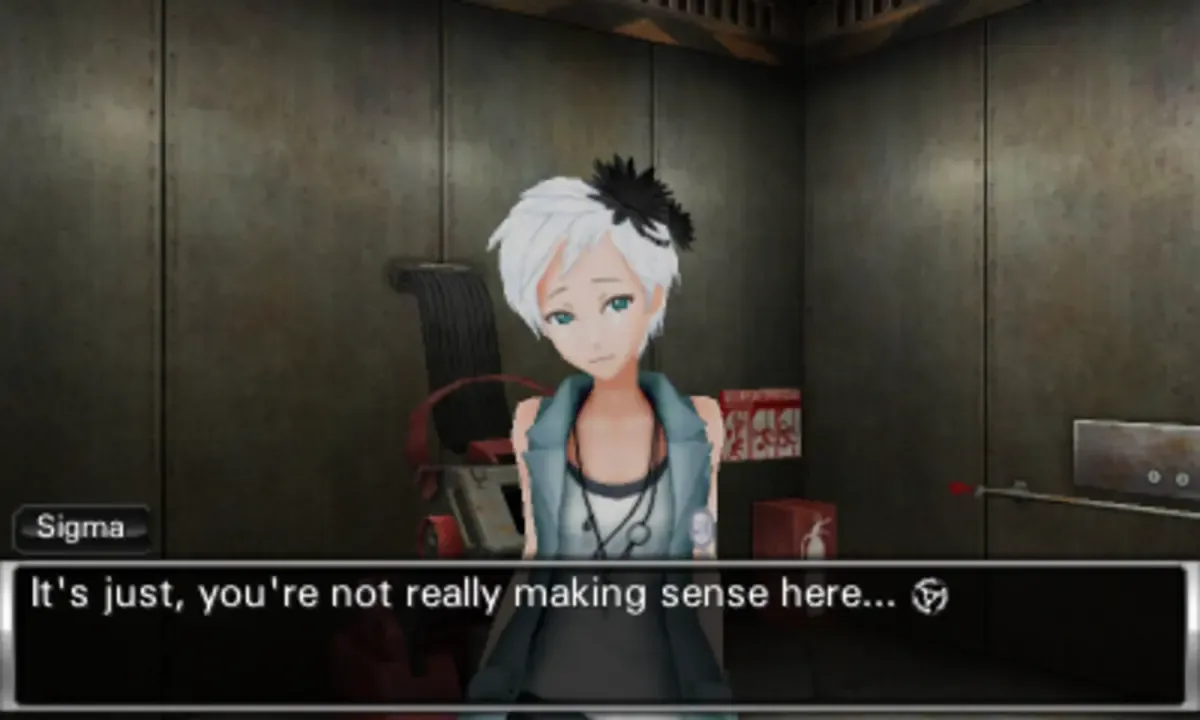
phi is this game’s june, though she’s much less outwardly soft than akane. she is likely this game’s best character; a hard-shelled, focused young woman whose role as sigma’s time-jumping buddy creates a bond between them that is really charming. she’s clearly got a heart of gold hidden underneath her layers of hardship, and by the end of the game, her and sigma clearly care for each other more than you would imagine when you boot up the game next to her. the dynamic she has with sigma is what makes the small moments in this game fun. a fantastically written character.
and, finally, sigma. he’s just junpei, but a little hornier and a lot dumber. he’s an extremely amicable guy, in general, who clearly cares for those around him even from the outset. because he’s a vessel for your actions, his character is obviously weaker than someone like phi’s, but as main characters go, he’s pretty good.
i think you see why i went through each of those characters individually. the vast majority of these characters share a narrative role with someone from 999, just… executed worse. alice, clover, k, and dio are all direct downgrades of tropes established by characters in 999, and quark is basically a non-character. that leaves luna, tenmyouji, phi and sigma to do this game’s heavy lifting both in plot and in emotion. having a cast of 9 characters where only 4 of them feel like actual human beings is just… sad.
it also doesn’t help that sigma feels so much dumber than junpei did. he consistently fails to make basic connections without phi or tenmyouji on his side. clover and dio are the same way; clover is almost unfathomably ditzy, and dio reveals his plans after far too little pressure, even being tricked by a literal loony tunes-ass strategy in one of the endings. when multiple, main, plot-driving characters (and clover) are just not that bright, it leads to this immense feeling of frustration. in games like these, it’s extremely hard to hit the balance of having the characters figure out major twists at the same time as the players. 999 was excellent at this; VLR is terrible at it.
the stupider characters, in tandem with an overall less-developed cast and extremely emotionally flat endings, lead to this game having almost no true emotional core. the closest thing you get is during luna’s end, and even then, it’s a very short segment at the end of a very long dialogue. it’s not that a game focused so heavily on the science aspect of science fiction needs an overly emotional ending… but a game with a structure like 999 or VLR BEGS for one.
i won’t speak much on the game’s true ending, because while i still think it’s absolutely terrible, i can also accept that some people may like it much more than i do. is it still poorly paced? yes, but not as bad as i remembered. does the pseudo-science stuff still rub me the wrong way? yes, but i can chalk that up to a personal preference in storytelling. does the main perspective twist still kinda blow? yes… and there’s no qualifier there.
the main problem, for me, is that this game ends with such a weird lack of closure. you talk with akane in the b. garden. you learn that you’re zero, and that you’re in your old man body or whatever. she explains how this whole scheme was to send sigma and phi to different points in time, so that they can rebuild the AB game, re-send sigma and phi to the mars test site, and stop this whole earth-ending thing from happening, and then she incites the event that sends sigma back and phi… somewhere else. and the game just kind of… ends. basically says “go do that in the next game”, without giving a satisfactory conclusion.
there’s a strong difference between a cliffhanger and what VLR does. a cliffhanger implies that some event has happened and you don’t know what’s going to happen next. usually you’ve reached some comfortable conclusion, and then something happens.
in VLR, you never reach a comfortable conclusion - the AB game just kind of unravels and everybody is stuck in this shitty timeline - and you know exactly what you’re going to do next, which is go to the mars test site. there’s no intrigue, and no comfortable ending. it just kind of… ends.
it’s the worst kind of ending. i don’t feel super invested into getting more, but also don’t feel like the vast majority of my questions have actually been answered. it’s the definition of underwhelming.
~
that’s what best describes virtue’s last reward: underwhelming. it’s a game built off the back of one of my favorite narratives in gaming, but every single element of it feels like a direct downgrade. there’s more content, but so little of it feels meaningful. there’s obviously some bright spots (i mean, phi probably carries this game’s rating up two points alone), but as a whole, it’s regrettably average.
score
5/10
notes
- developed by Spike Chunsoft
- published by Spike Chunsoft
- released in 2012
- played nonary games port
- played on pc
- crossposted to backloggd